In-situ testing forms the backbone of geotechnical investigations across Dallas, providing engineers and contractors with direct, undisturbed measurements of soil and rock properties at their natural location. Unlike laboratory tests that rely on transported samples, in-situ methods capture the true state of subsurface materials—accounting for moisture, density, stratigraphy, and stress conditions that are notoriously difficult to replicate. In a region where expansive clays and variable alluvial deposits dominate the near-surface geology, relying solely on lab data can lead to costly misinterpretations. The field density test (sand cone method) exemplifies this approach, delivering immediate compaction verification that directly informs foundation design and earthwork acceptance.
Dallas sits atop the Eagle Ford Shale and Austin Chalk formations, overlain by thick sequences of Quaternary alluvium along the Trinity River floodplain and its tributaries. These younger deposits are characterized by stiff to very stiff clays of the Taylor Marl and Ozan formations, interspersed with silty and sandy lenses that exhibit significant shrink-swell potential. Seasonal moisture fluctuations cause these clay-rich soils to expand and contract dramatically, exerting differential movement on shallow foundations and pavements. In-situ testing—from standard penetration tests (SPT) to cone penetration tests (CPT) and pressuremeter tests—becomes essential for mapping the depth and severity of these active zones, allowing engineers to design pier-and-beam systems or post-tensioned slabs that accommodate ground movement without structural distress.
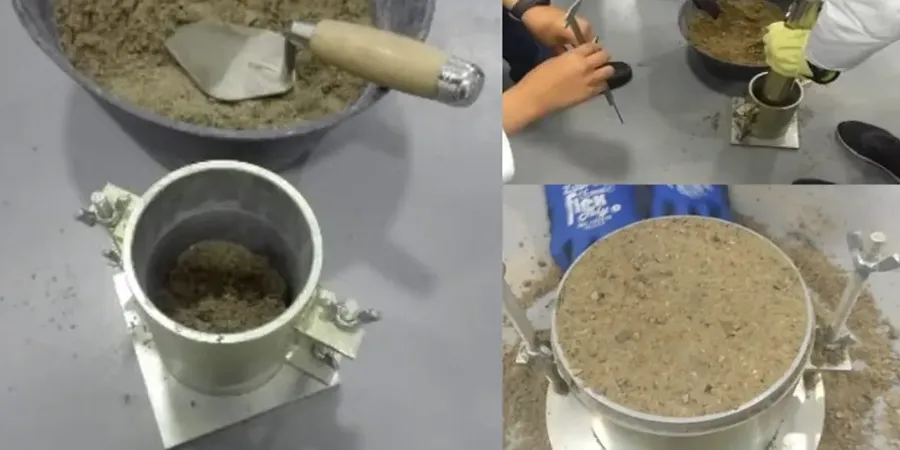
Regulatory compliance in Dallas follows the International Building Code (IBC) as adopted by the City of Dallas, which mandates geotechnical investigations conforming to ASTM International standards. ASTM D1586 governs the SPT, while ASTM D5778 covers CPT procedures, and ASTM D1556 specifically addresses the field density test (sand cone method) for soil compaction control. The Texas Department of Transportation (TxDOT) further enforces its own specifications for transportation projects, including Tex-115-E for field density determination. Local amendments within Dallas County often require in-situ verification of bearing capacity and settlement potential for any structure exceeding two stories, making these tests non-negotiable for commercial and multi-family residential developments. Environmental site assessments under TCEQ guidelines also rely on in-situ permeability testing when evaluating contamination migration pathways in the expansive clay matrices common to North Texas.
The range of projects demanding in-situ testing in Dallas spans from high-rise towers in the Arts District to sprawling logistics centers in South Dallas County. Foundation design for the booming residential subdivisions in Frisco and McKinney hinges on accurate in-situ moisture content and density profiles, often obtained through nuclear gauge testing or the field density test (sand cone method) during fill placement. Pavement subgrade evaluations along the LBJ Freeway expansion utilized dynamic cone penetrometers (DCP) to verify lime-stabilized subgrade performance, while deep excavations near the Trinity River require in-situ vane shear tests to assess soft clay stability. Retaining wall designs, slope stability analyses for creek bank remediation, and even forensic investigations of distressed structures all depend on the reliable, site-specific data that only in-situ methods can provide.
Available services
Common questions
What is the primary purpose of in-situ testing in geotechnical engineering?
In-situ testing evaluates soil and rock properties without removing samples from their natural environment, preserving stress states, moisture conditions, and fabric. This direct measurement approach provides more reliable data for foundation design, slope stability analysis, and earthwork quality control compared to laboratory tests on disturbed samples, particularly in sensitive or heterogeneous deposits.
How do local soil conditions in Dallas influence the selection of in-situ test methods?
Dallas soils are dominated by expansive clays and interbedded alluvial deposits with high shrink-swell potential. In-situ methods like the pressuremeter test and cone penetration test are preferred because they capture undrained shear strength and compressibility in these moisture-sensitive materials, helping engineers design foundations that accommodate seasonal volume changes without structural damage.
Which ASTM standards govern in-situ testing for construction projects in Dallas?
Key ASTM standards include D1586 for standard penetration testing, D5778 for cone penetration testing, D1556 for the sand cone density method, and D2573 for field vane shear tests. The City of Dallas adopts the IBC, which references these ASTM procedures, while TxDOT projects may additionally require Tex-115-E for density verification on transportation infrastructure.
When are in-situ density tests required during construction in the Dallas area?
In-situ density tests are mandated during fill placement and compaction for building pads, roadway subgrades, utility trench backfill, and retaining wall construction. Testing frequency follows project specifications or local building codes, typically requiring verification every 1,500 to 3,000 square feet per lift to ensure compliance with engineered compaction criteria and prevent future settlement.